
The four costs of AI and how to mitigate them
I was recently delivering a senior leadership development session, and one of the internal presenters, discussing operational efficiency, shared the advanced plans to automate the overtime system. As she put it: “it’s currently such a cumbersome process, with lots of people involved. AI will take all of that away.” And it will. But what else will it remove?
Let me just start by stating that I am a huge fan of AI – I use it constantly, and the power, accuracy and speed it offers is off the chart. It’s a game changer, and helps me work at a level I’ve never experienced before. We are also talking to, and helping, many organisations to understand what it’s going to mean practically for them. So this isn’t an article damning the technology, it’s one that’s examining the cultural impact it invariably will bring. Further, it’s also a look at the criticality of leadership in all of this – how our people managers own the conversation and the need to steer people through this new landscape and, hopefully, end up in a better place.
Recently, during a roundtable discussion, I used the analogy of the lighthouse. How, with the invention of electricity, and subsequent advances in cables, machinery and systems, the job of lighthouse keeper has gone completely. But, in its place, has come many new ones – people that manage the automated systems, maintain the remote stations, and provide the power. Jobs don’t disappear, they change.
To put that into context, in the UK in 1976 the unemployment rate was 2.03%. Over the intervening 50 years we’ve seen seismic shifts in industrial automation, office computing, digitisation, internet, service automation and virtualisation. The net impact of all these advances (which were all cited as ‘job killers’ when first introduced) is 0.61%. That’s the increase in unemployment from then until today. Of course, the job market has many other factors – financial turmoil, changing retail models, skills misalignment and global mobility. But still, the point stands – we have yet to see something arise that kicks the legs from underneath the job market.
So too, we believe, it will be with AI. It will remove some jobs, but create others. The simple advice I was given recently was that the only people who should worry were ‘those that are not using AI’. But, If it’s not jobs, then what WILL AI remove?
The Four Costs of AI
To answer this, let’s first look back to the comment from the guest speaker. Yes, the efficiency will be there through automation of the overtime process, but the impact will be all those moments of interaction that the current, inefficient, process creates. And that’s the first cost. As we move human-delivered tasks into automated processes, we ‘lose the connections that create and sustain our organisation’s culture’. A highly automated company will be a pretty soulless place to inhabit.
Secondly, let’s take the example of NFTs. To bring you up to speed, the market for them has collapsed – most are now considered worthless. Some estimates say that’s a loss of $3.2 billion. It was a tulip bubble waiting to happen. A number of the reasons why demonstrate our disdain for virtual, computer created outputs. Some NFTs were hand-made originals, but many were ‘copyminted’ – spat out by computers. They held no ‘art’ for us, and didn’t create the right emotional responses. Beauty isn’t a simple concept – we really only apply it when we think there’s either been effort behind it, or it’s something that’s happened because of the unlikely alignment of the universe’s myriad components.
Our heart skips a beat when we see a red sunset on a calm shore, silhouetting a sailboat. But when we know that image is generated by AI, we have little reaction. Given this, our second cost will be ‘the loss of perceived authenticity, and thus value’, that we will apply to many things. As one quick case example, I was told recently by a senior person that “we can just use AI to give us our company values”. Yes, yes you can, but would anyone actually feel any affinity towards them? Items won easily hold very little value to us. A real example of the value dip is the disinhibition demonstrated by people when interacting with AI chat bots. We are ruder and more aggressive with them when we know it’s not another person on the other end.
Thirdly, we are going to see a cost of ‘the absence of fortuitous mistakes.’ Humans are messy and prone to error. Removing them seems like a boon, until you factor in that many of our advances as a species have been through the ‘oops’ moments that changed our world. Around three million people owe their lives to one – the inventor of the pacemaker used the wrong part in a machine he was trying to build to record heartbeats. Without mistakes we wouldn’t have penicillin, x-rays, microwave ovens, car tyres or post-it notes. AI risks hindering non-biological evolution for us. We need humans in the mix, getting it wrong, and having the curiosity and attention to spot the opportunity.
My car recently broke down. Right in the worst spot imaginable. Cue lots of angry commuters honking their horns at me and making interesting gestures. In a brave attempt to rectify the situation, I opened the bonnet and peered into the engine bay. It was a sea of black plastic and mystery. I had zero chance of fixing it. By contrast, I constantly had my hands in the engine of my first car – a mark five Cortina. One of my most critical tools was a large hammer to hit the starter motor with when it jammed (a frequent situation).
When we black-box workings, we remove our ability to problem solve and innovate a fix. So there’s our fourth cost: ‘removing the ability to engineer quick solutions and fixes’. One of my team summed it up nicely – “If you work in a restaurant, and the payment system goes down, you break out the old physical card machine – that goes ‘ker-thunk’ as you slide it over the card. But you can’t jam someone’s phone into it to charge their Apple Wallet.” AI will create front end interfaces that most of us have no idea what is behind them. This removes control and adaptability.
Doubtless, there are many other costs to consider. But these are the ones that stand out most. Are they the ‘four horsemen of the AI-pocalypse?’ Only if we let them be. The solution isn’t to stop the AI progression, far from it. Smart leaders are looking at how they rebuild their organisation with them at the centre, rather than keep them as tools on the periphery (if your organisation is still debating whether or not to allow access to ChatGPT, you are SO behind the curve). They will be a major feature for future working.
To combat the four costs, we need to lead and interact in different ways. We have to, right now, start educating our people managers on the importance, and practicalities, of turning up human-centred judgement and warmth. As AI removes the connections, the messy human activity and the attachment, we’ve got to strengthen the people bonds more than ever. What we tasted in COVID, when isolation was a significant factor, was just the foothills of the mountain to climb.
Utilising the time and space that AI creates will be the most significant differentiator between organisations that suffer cultural loss, versus those that accelerate it. Amplifying the quality of time together and building more depth in relationships will be critical. We cannot let our professional connections wither – a real risk.
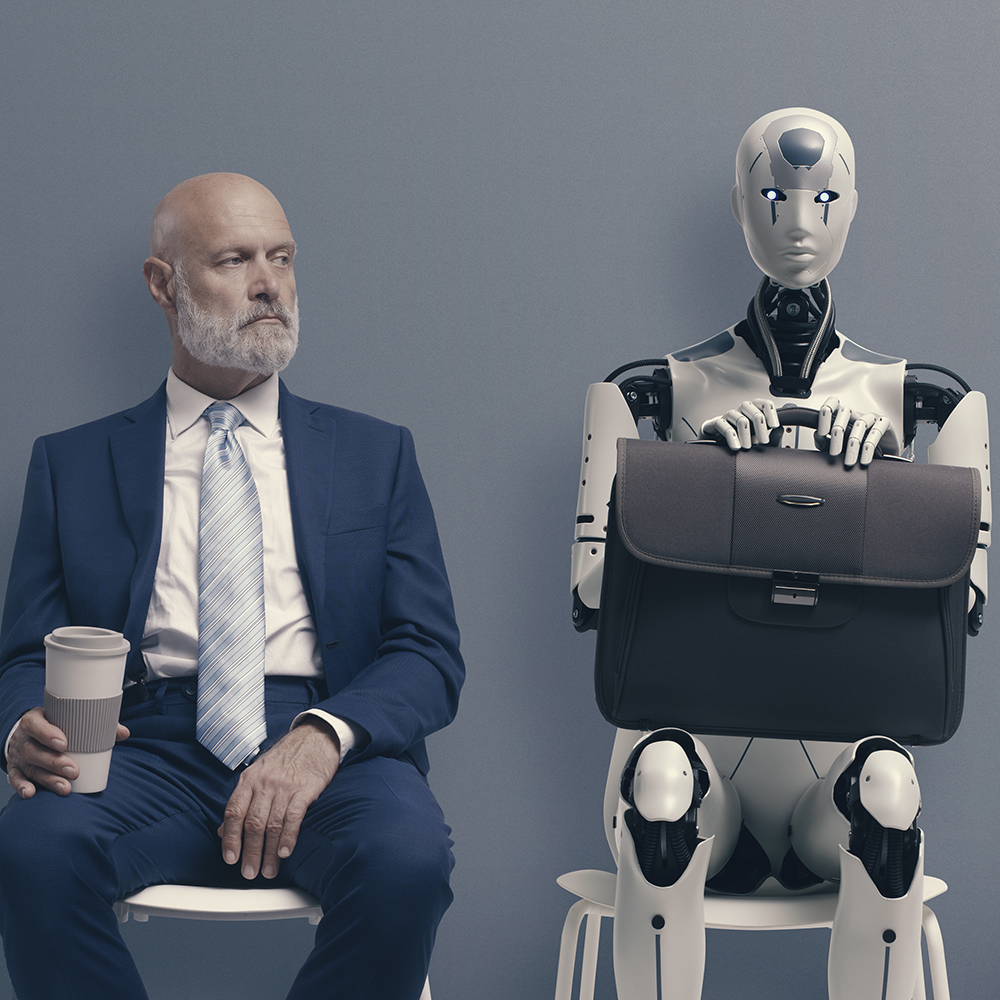
An average of the numerous forecasts regarding reduction in workforces caused by AI suggests that many companies will see circa 20% drops. Sounds, and is hefty, and potentially challenges my ‘AI’s not a job-killer’ statement. However, the desktop computer is estimated to have actually removed a bigger percentage of roles from many organisations, but that happened without a corresponding rise in unemployment. The ablation is gradual, and often syncs with generational shifts and population trends.
Ultimately, that leaves 80% of us stepping into a brave new world, where AI chatbots are our mainstays. Our work output is far more complex, but the route to creating it is hugely more simplified – using tools that we have little understanding of beyond the front end presented to us. It’s a future of spare time and opportunity, perhaps the next big leap for humanity. But, let’s ensure we enjoy it.
The critical need is to maintain humanity within this new paradigm. This has to be our number one priority as leaders – recognising the impacts of technological change and working to mobilise, mitigate and monopolise them. And this starts now. Great leaders are already having conversations about the shifts, and the ways that teams and individuals can utilise these increasingly powerful tools in effective, ethical ways that give us more time to do the great stuff together.
So, what’s your story on the future for your people?
Chris Preston
Founder
The Culture Builders